
10 Local SEO Mistakes That Prevent Small Businesses from Ranking on Google
Local SEO mistakes can prevent small businesses from appearing in Google Search and Google Maps when nearby customers are ready to buy.
They usually search for a nearby service, compare a few results, check reviews, visit one or two websites, and contact the business that appears most relevant and trustworthy.
That makes local search visibility extremely important for small businesses.
However, simply creating a website or Google Business Profile does not guarantee that your company will appear prominently in local search results.
Google considers factors such as relevance, distance, and prominence when displaying local businesses. Businesses must therefore provide clear, accurate, and consistent information across their website and online profiles.
Unfortunately, many small businesses unknowingly make mistakes that weaken these signals.
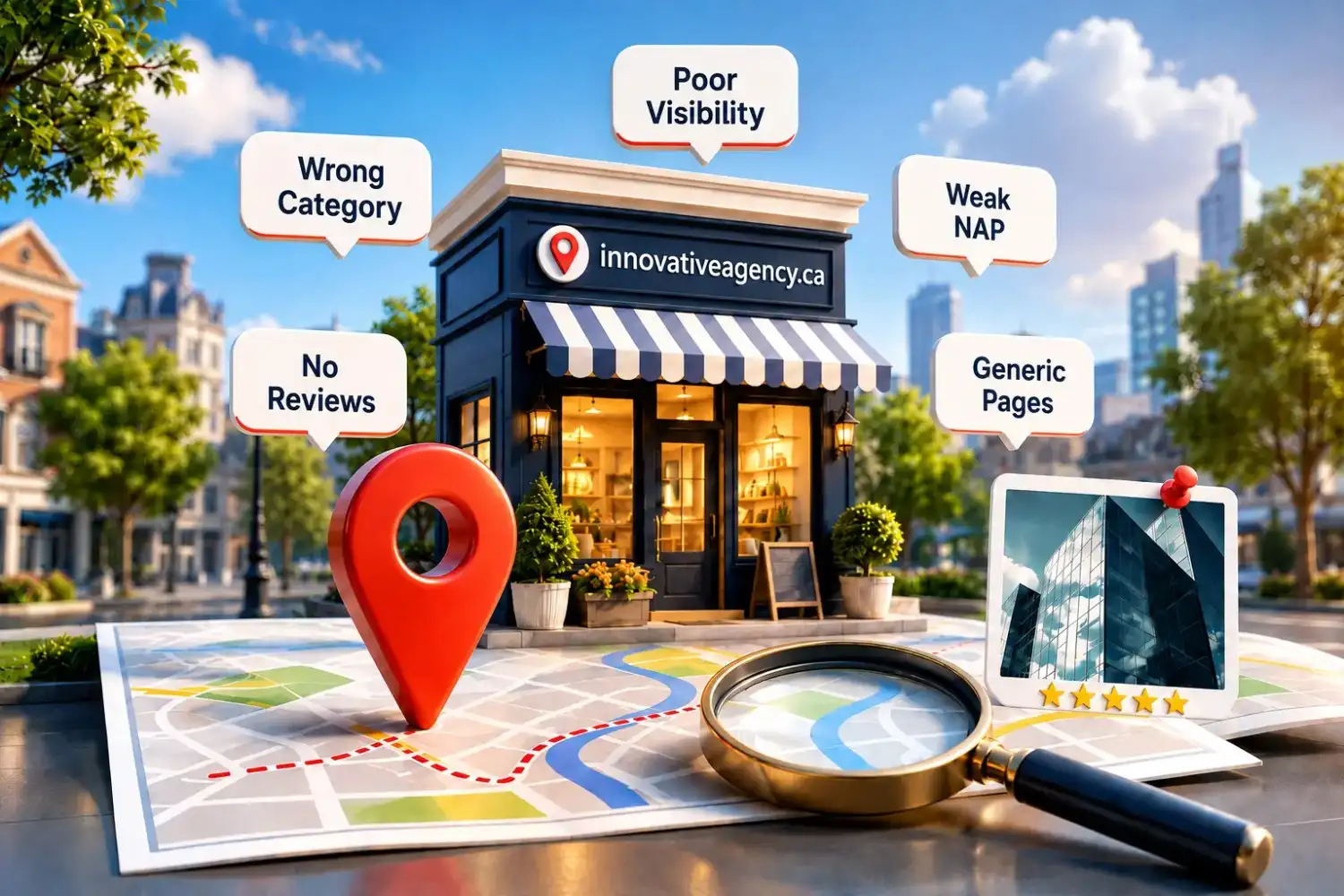
Why Local SEO Mistakes Hurt Small Business Rankings
Search engines use business information, relevance, reviews, website quality, and local authority to understand which companies deserve visibility. Even small inconsistencies can weaken these signals and reduce local rankings.
1. Using Inconsistent Business Information
Your business name, address, and phone number should remain consistent wherever your company appears online.
This information is commonly referred to as NAP:
- Name
- Address
- Phone number
Problems occur when one platform displays an old address, another shows a different phone number, and your website uses a slightly different business name.
For example:
Website: Innovative Digital Agency Canada
Directory listing: Innovative Agency
Google Business Profile: Innovative Agency Canada Inc.
These variations may appear minor, but they can create confusion for customers and search engines.
Choose one official format and use it consistently across:
- Your website
- Google Business Profile
- Social media profiles
- Business directories
- Review platforms
- Local citations
Whenever your address, phone number, or business name changes, update all important listings as soon as possible.
2. Leaving the Google Business Profile Incomplete
An incomplete Google Business Profile gives potential customers less information and may reduce the relevance of your listing.
Businesses often create a profile but fail to complete important sections.
Your profile should include:
- Correct business name
- Accurate address or service area
- Primary business category
- Additional relevant categories
- Opening hours
- Phone number
- Website address
- Business description
- Services
- Products, where applicable
- Recent photographs
Every field should help customers understand what your company does and whether it can meet their needs.
Avoid adding unnecessary keywords to your business name. Use the real-world name that appears on your website, signage, and official documents.
3. Selecting the Wrong Business Category
Your primary business category helps Google understand the main service your company provides.
A broad or inaccurate category can make it harder for your business to appear for relevant searches.
For example, a company specializing in website design should select the closest available category related to website design rather than relying only on a broad category such as marketing agency.
The primary category should represent the company’s most important service.
Additional categories can cover closely related services, but businesses should avoid selecting categories that do not accurately describe their work.
Review your categories periodically because services and business priorities can change.
4. Creating One Generic Service Page
Many small-business websites list all services on a single page.
This makes it difficult to provide detailed information about each service and limits the number of relevant searches the website can target.
Suppose an agency offers:
- Website design
- Website development
- Website redesign
- Local SEO
- Website maintenance
Placing every service in a few short paragraphs on one page does not give search engines or potential customers enough context.
A better approach is to create a dedicated page for every major service.
Each page should explain:
- What the service includes
- Who it is for
- What problems it solves
- How the process works
- What makes the company different
- What action the visitor should take next
Dedicated service pages can target more specific search intent while giving visitors the information required to make a decision.
5. Repeating the Same Location Content
Businesses serving multiple locations sometimes create several city pages by changing only the city name.
For example:
“Website design services in Toronto”
may become:
“Website design services in Brampton”
while every other sentence remains identical.
This creates weak pages that provide little unique value.
A useful location page should contain information specifically connected with that market.
It may include:
- Services available in that area
- Types of businesses commonly served
- Local customer needs
- Relevant projects or examples
- Service-area details
- Location-specific frequently asked questions
- A clear contact option
Do not create hundreds of location pages simply to target keywords.
Create a page only when your business genuinely serves that location and can provide meaningful, location-relevant information.
6. Ignoring Customer Reviews
Reviews influence how potential customers evaluate a local business.
A company with recent, detailed reviews usually appears more trustworthy than a business with no feedback or only a few outdated reviews.
Many businesses make one of two mistakes:
- They never ask customers for reviews.
- They ask every customer to leave the same generic comment.
Instead, create a simple and ethical review process.
After completing a project or delivering a service, send the customer a direct review link. Ask them to describe their genuine experience without telling them exactly what to write.
Useful reviews often mention:
- The service received
- The problem that was solved
- Communication quality
- Professionalism
- Results or improvements
- The customer’s location or industry
Respond professionally to positive and negative reviews.
Your response shows future customers that the business values feedback and takes customer experience seriously.
7. Failing to Optimize the Website for Mobile Visitors
Many local searches happen when customers need a fast answer.
They may be looking for:
- A nearby service provider
- Business hours
- Directions
- A phone number
- An urgent quote
- Information about availability
If the website is difficult to use on a phone, the visitor may return to the search results and contact a competitor.
A mobile-friendly local business website should have:
- Readable text
- Simple navigation
- Clearly visible buttons
- Fast-loading pages
- Short forms
- Clickable phone numbers
- Properly sized images
- No overlapping content
Test important pages on different screen sizes.
Pay particular attention to the homepage, service pages, contact page, and quote-request form.
8. Publishing Content Without Local Search Intent
Blogging can support SEO, but publishing random articles will not necessarily attract potential customers.
The content should answer questions your target audience is already asking.
A local web design agency, for example, could publish articles such as:
- How much does website design cost in Canada?
- How long does it take to build a small-business website?
- Should a local business use WordPress?
- Why is my business not appearing on Google Maps?
- What should a Canadian business website include?
- How often should a company redesign its website?
These topics connect informational searches with the agency’s services.
Each article should provide a complete answer and then direct readers toward a relevant service page when appropriate.
Avoid inserting keywords unnaturally. Write primarily for the person searching for help.
9. Forgetting Internal Links
Internal links connect one page of your website with another.
They help visitors find relevant information and help search engines understand the relationship between your pages.
For example, a blog about local search mistakes can link naturally to:
- A Local SEO service page
- A website design service page
- A related Google Business Profile article
- A contact or consultation page
Use descriptive anchor text.
Instead of writing:
“Click here to learn more,”
write:
“Explore our Local SEO services for Canadian businesses.”
Descriptive links tell visitors what they will find after selecting the link.
Avoid adding too many unrelated links. Every internal link should support the reader’s journey.
10. Expecting Immediate Results
Local SEO is not a one-time setup.
Completing a business profile, publishing a few pages, and adding several keywords will not always produce immediate rankings.
Local visibility develops through consistent improvements, including:
- Maintaining accurate business information
- Publishing useful service content
- Collecting genuine customer reviews
- Improving website usability
- Building local authority
- Updating the Google Business Profile
- Fixing technical website issues
- Earning relevant mentions and links
- Monitoring performance
Businesses should evaluate progress using meaningful outcomes rather than focusing only on rankings.
Important local SEO measurements include:
- Organic website traffic
- Calls from local search
- Quote requests
- Form submissions
- Direction requests
- Google Business Profile interactions
- Conversion rates
- Searches that generate leads
SEO rankings are valuable only when they help the business attract relevant customers.
How to Fix Common Local SEO Mistakes
A successful local SEO strategy connects your Google Business Profile, website, service pages, reviews, and local business information.
Start with a complete audit.
Check whether:
- Your business information is accurate
- Your primary category is relevant
- Every important service has a dedicated page
- Your website works properly on mobile devices
- Location pages contain unique information
- Customers can contact you easily
- Reviews are recent and genuine
- Internal links guide visitors toward important pages
- Your content answers real customer questions
- Website performance is being measured
Fix the most important issues first.
For example, improving inaccurate contact information and weak service pages may create more value than publishing several new blog posts.
Local SEO Is About Relevance and Trust
Local SEO should not be treated as a process of adding city names to every page.
Its purpose is to make your business easier to understand, discover, and trust.
Search engines need clear information about:
- What your business offers
- Where it operates
- Who it serves
- Why it is credible
Customers need many of the same answers.
When your website and business profiles provide this information consistently, your company has a stronger foundation for sustainable local visibility.
Improve Your Local Search Visibility
If your business is not appearing for relevant local searches, the problem may involve more than a few missing keywords.
Your website structure, service pages, Google Business Profile, reviews, mobile experience, and business information must work together.
Innovative Agency Canada provides Local SEO and website optimization services designed to help Canadian businesses improve their online visibility and attract more relevant local customers.
A professional Local SEO audit can identify missed opportunities, technical problems, and content gaps that may be limiting your growth.
Start by reviewing your current local presence and building a strategy focused on long-term visibility rather than temporary ranking tactics.
Fixing these local SEO mistakes can help your business improve local visibility, build trust, and attract more qualified customers.
🍁 Get updates
Join Our Web Design Insights Community


4689 weekly subscribe
Subscribe to receive practical website design insights, website best practices, and updates that help businesses improve their online presence. No spam—just useful information you can actually apply.